
There was a season of my life when my mind felt like it had a mind of its own.
The kind of mental noise that follows you into the shower, into traffic, into bed—then wakes you up at 3:17 a.m. to replay old conversations like a courtroom drama you never asked to attend.
What helped me most wasn’t forcing my thoughts to stop. It was giving my attention somewhere kinder to land.
That’s the quiet power of a mantra.
A mantra isn’t magic. It’s not a personality transplant. It’s not a “perfect vibes only” spell. It’s something much more practical : a simple phrase or sound you return to again and again until your nervous system starts believing, I can come back to safety. I can come back to now.
And when you practice it consistently—especially on the hard days—something begins to shift. Not just in your mood, but in your identity.
If you’re newer here, you’ll hear pieces of my story woven through this site. Meditation became a cornerstone of my healing and my rebuild, and I share more of that journey on my About Me page.
Now let’s five deeper.
Affiliate Disclosure: Some links on this page may be affiliate links, which means I may earn a small commission at no extra cost to you. I only share resources I genuinely believe can support you.
What Mantras Are
A meditation mantra is a word, phrase, syllable, or short prayer repeated—silently or out loud—to anchor attention.
Historically, mantras have roots in Asian spiritual traditions, especially Hinduism and Buddhism, where they’ve been used for centuries as sacred utterances repeated in practice.
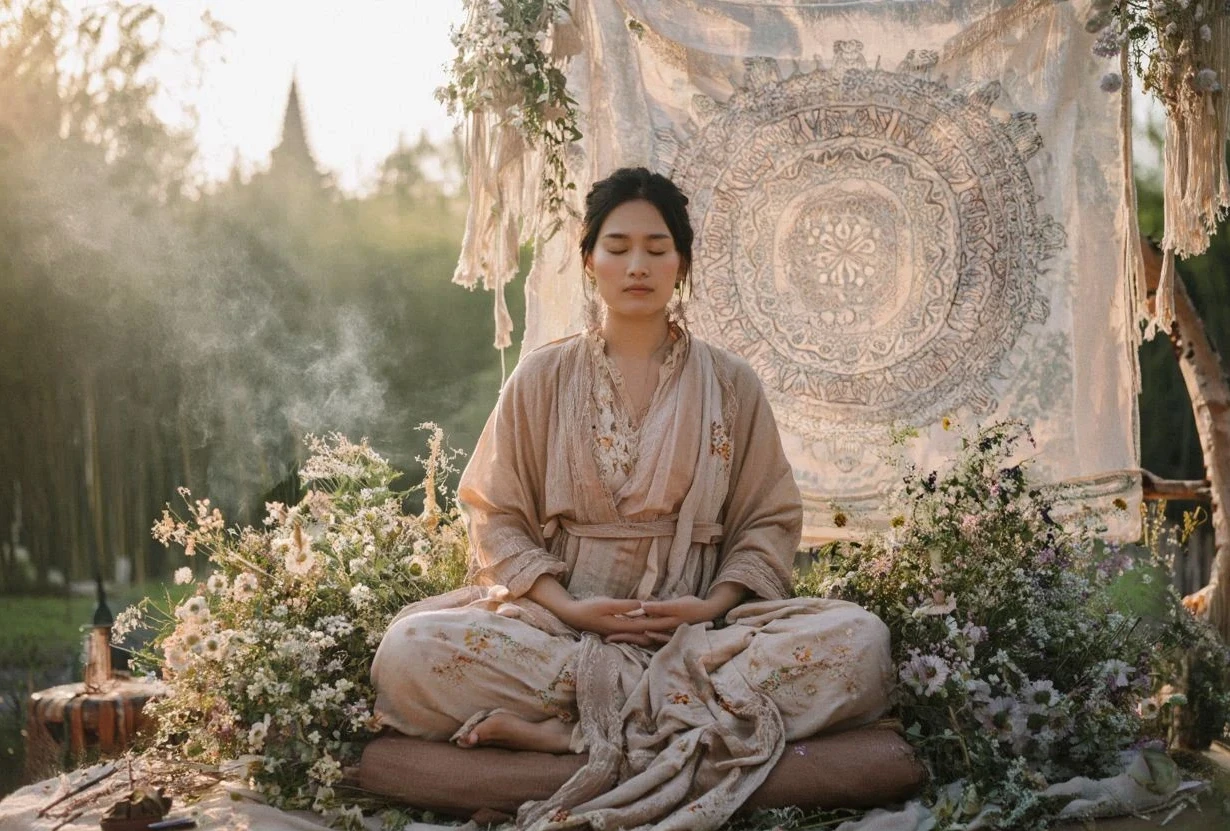
But in modern practice, “mantra” can be spiritual or secular. The defining feature isn’t the language—it’s the repetition.
Think of a mantra like a handrail for your mind. When your thoughts spiral, you don’t have to argue with them. You just return to the handrail.
Where Mantras Come From
Mantras show up across many traditions:
- Hindu traditions often include sacred syllables like Om (Aum) and “seed” sounds used for focus and devotion.
- Buddhist traditions use mantras as steadying phrases for compassion, wisdom, and presence.
- Modern clinical programs sometimes use “mantram repetition” in a structured way for stress regulation and emotional self-management.
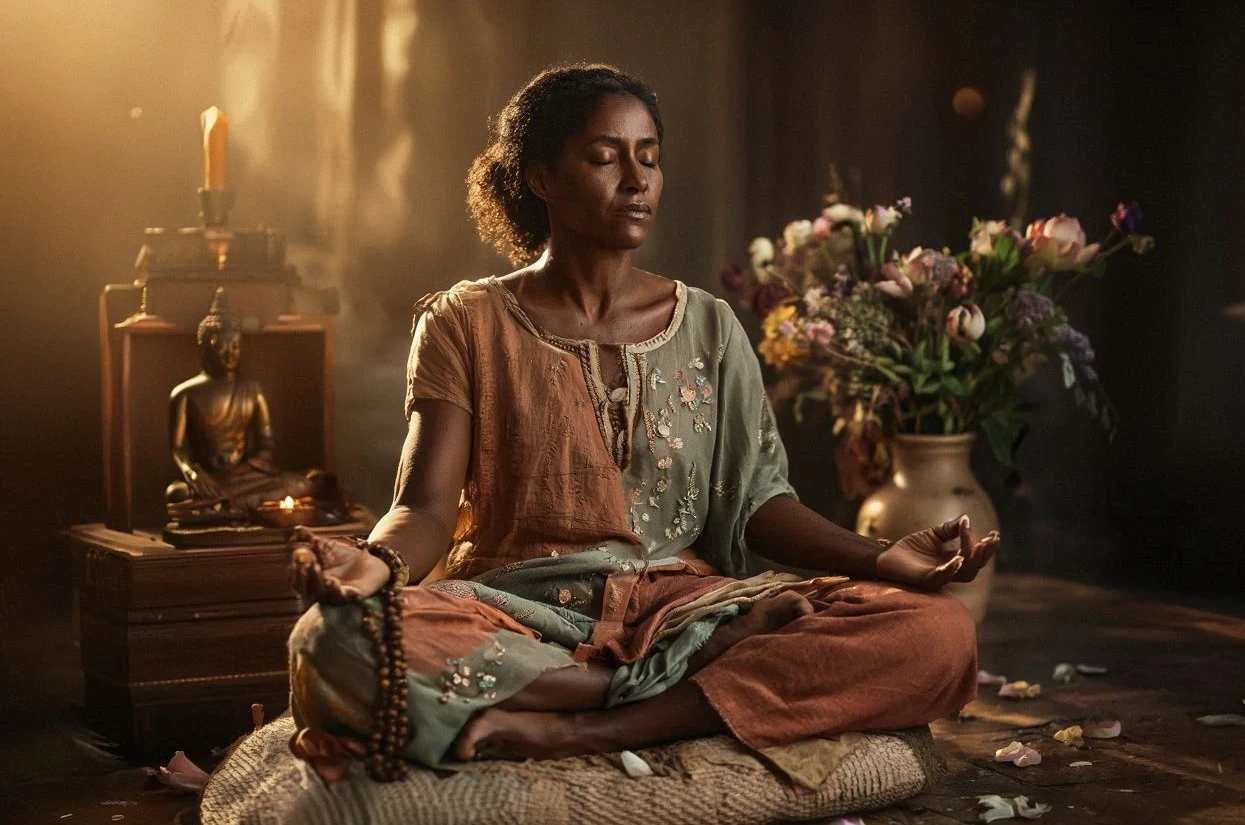
So whether your mantra is ancient Sanskrit, a short prayer, or a grounding phrase in plain English—your brain and body still learn the same skill:
Return. Repeat. Regulate.
Why Mantras Support Mindfulness
Mindfulness is often described as paying attention on purpose, in the present moment, without judgment—a definition widely attributed to Jon Kabat-Zinn.
A mantra helps you do that without wrestling your thoughts.
You’re not trying to “win” meditation.
You’re practicing the ability to come back.
The Benefits
Below are the seven transformations I see most often—both personally and in the research.
1) Calm arrives faster than silence

Silence can be beautiful… unless your mind uses silence as a blank screen to project every fear you’ve ever had.
A mantra gives your attention something steady to hold.
This aligns with what Harvard Health Publishing describes in the relaxation response: repeating a word or phrase and returning to it when thoughts wander can help shift the body out of stress reactivity.
Quick tip: If silent meditation feels agitating right now, try mantra meditation first. It’s not “less advanced.” It’s simply more supportive for a busy nervous system.
2) The Power Of Repetition
Your subconscious is heavily influenced by repetition—what you rehearse internally becomes what your brain expects, and what your nervous system recognizes.
Meditation isn’t only about relaxation; it’s also attention training. Over time, meditation practice is associated with brain changes in regions tied to learning, memory, and emotion regulation.
Long-term meditation experience has also been associated with differences in cortical thickness in areas related to sensory and interoceptive processing.
Do those studies “prove” that one specific mantra rewires you overnight? No.
But they strongly support the bigger truth: your brain changes through practice. And mantra meditation is a form of practice that builds new mental grooves through repeated return.
Mini mantra for rewiring:
“I return to calm.”
Not because you always feel calm, but because you are training the return.
3) Mantras regulate the nervous system

Some mantra practices have measurable physiological effects.
For example, brief Om chanting has been studied in relation to heart rate variability (HRV), a marker often associated with autonomic balance and parasympathetic activity (the “rest and digest” side of the nervous system).
And on the mental health side: mantram repetition interventions have been examined in adult populations, including a body of research summarized in systematic reviews.
One well-known clinical trial in veterans with PTSD found mantram repetition therapy was generally more effective than a comparison therapy for reducing PTSD symptom severity and insomnia.
4) Meaning matters, but feeling matters more
A lot of people get stuck searching for the “perfect” mantra.
Here’s what I’ve learned: the mantra doesn’t have to be impressive. It has to be believable to your body.
Meaning helps because it gives direction.
But feeling matters because it’s what your nervous system actually absorbs.
Sometimes the most powerful mantra isn’t poetic. It’s simple:
- “I am safe right now.”
- “This moment is enough.”
- “Slow is okay.”
If you want something similar (and aligned with what you already read here), you might also like my post How Affirmations Improve Meditation.
5) Mantras train focus without force

Focus doesn’t have to be harsh.
Mantra meditation builds what psychologists sometimes call “attentional control” the gentle way: you notice distraction, then return.
And that practice shows up everywhere:
- in conversations (less “zoning out”)
- in work (less context switching)
- in emotional moments (more pause before reaction)
If you want a broader overview of meditation styles (including mantra and loving-kindness phrases), check out Different Types of Meditation for Beginners.
6) Mantras reshape your identity
This is the part people don’t talk about enough.
When you repeat a mantra consistently, you’re not only calming down. You’re also making an identity statement:
- “I’m the kind of person who returns to my breath.”
- “I’m the kind of person who speaks to myself kindly.”
- “I’m the kind of person who can be with discomfort and still choose presence.”
Over time, you stop asking, “Am I doing meditation right?”
and start living from, “I am someone who comes back to myself.”
7) Consistency beats complexity
Your nervous system doesn’t need your most elaborate routine.
It needs your return.
A few minutes daily, done imperfectly, tends to outwork the “perfect” plan you do twice a month.
For readers building a simple rhythm, my post Meditation Habits That Build Inner Peace pairs beautifully with mantra work.
How to Choose a Mantra
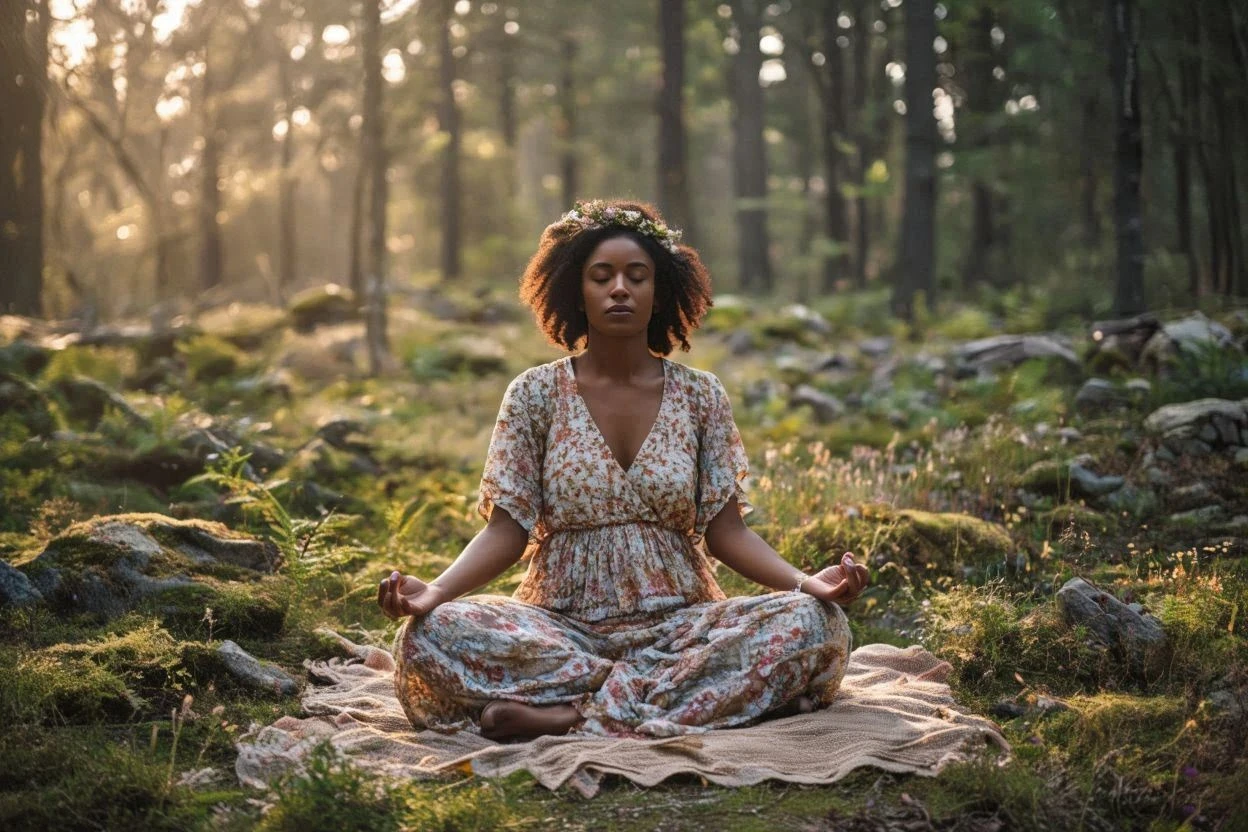
Choosing a mantra is less like picking a tattoo and more like choosing a supportive pair of shoes.
Try it on. Walk with it. Keep what helps.
A simple way to decide
Ask yourself:
- What do I need more of right now?
Calm? Courage? Compassion? Focus? Healing? - What feels believable today?
- Can I repeat it without tension?
If it feels like a demand, soften it.
Popular Mantras
Here are a few widely used options, with gentle context:
- Om (Aum) — a sacred syllable used in many Hindu traditions; often treated as a vibrational anchor.
- So Hum — often interpreted as “I am that” / “I am,” commonly used with the breath.
- Sat Nam — often translated as “truth is my identity.”
- Om Mani Padme Hum — a Buddhist mantra associated with compassion.
- Loving-kindness phrases — “May I be safe. May I be peaceful. May I be happy.”
And if you want a bridge between mantra and affirmations, you can borrow from my 200 Mindfulness & Meditation Affirmations list and choose one short line to repeat as a mantra.
YouTube Practices You Can Use
If you want guidance (especially helpful when building consistency), here are a few options worth trying:
- A guided mindfulness meditation from Jon Kabat-Zinn (good for grounding attention training).
- A simple guided So Hum mantra meditation (helpful if you want breath + mantra structure).
FAQ’s
Do I need a Sanskrit mantra for it to “work”?
No. The benefits come from attention + repetition + return. Traditional mantras have deep roots, but a simple phrase in English can be just as effective for anchoring your mind.
What if my mind won’t stop talking?
That’s normal. Meditation is not the absence of thought—it’s the practice of returning. A mantra gives you a friendly “home base.”
How long should I practice?
Start with 3–5 minutes daily. Increase when it feels natural. Consistency matters more than duration.
Is mantra meditation religious?
It can be, but it doesn’t have to be. Mantras come from spiritual traditions, yet many people use mantram repetition in a secular way for mental clarity and emotional regulation.
What if repeating words feels fake?
Choose something more neutral and body-friendly, like:
- “Here.”
- “Breathing in, breathing out.”
- “Softening.”
Truth can be quiet.
Can I combine a mantra with journaling?
Yes—and it’s powerful. Do 3 minutes of mantra, then write one paragraph: What did I notice?
If you want prompts, here’s my 10 Journal Prompts to Inspire Your Daily Meditation post.
Is it okay to do mantra meditation when I’m triggered?
Sometimes yes, sometimes no. If it helps you regulate, keep it gentle and short. If it intensifies emotions, try grounding with eyes open, feeling your feet, or using support from a therapist.
Disclosure: This information is for educational purposes only and isn’t medical or mental health advice. If you’re dealing with trauma, panic, or intense triggers, consider working with a licensed therapist or qualified professional for personalized support.
Recommended Books
If you want to go deeper, these three are supportive companions:
- “The Relaxation Response” — Herbert Benson
A classic, practical doorway into repetition-based calming and stress physiology.
- “Healing Mantras” — Thomas Ashley-Farrand
A grounded guide to traditional mantras with context and practical ways to work with them.
- “Wherever You Go, There You Are” — Jon Kabat-Zinn
Not strictly “mantra-only,” but excellent for building the core skill that makes mantra work transformative: returning with kindness.
Closing
Mantra meditation teaches you that you don’t have to fight your thoughts to find relief. You don’t have to wait until life calms down to feel steady. You practice coming back—back to your breath, back to your body, back to the part of you that can witness the moment without becoming it. And that return matters, even when it’s messy. Especially when it’s messy.
Some days your mantra will feel like a soft landing. Other days it might feel like you’re just holding on. Both count. Because every time you choose to come back—after distraction, after stress, after a trigger—you’re strengthening something deeper than focus. You’re strengthening trust in yourself. You’re teaching your nervous system that you can move through life and still have a home inside you.
If this resonated, I’d truly love to hear from you in the comments. What mantra are you drawn to right now? What are you working through? And what wins—big or small—have you noticed when you keep showing up?
With love, Deeana — Meditate4Calm