When I think back to how my mindfulness journey began, I realize it wasn’t about mastering any fancy technique — it was about learning how to come home to myself. I don’t have a formal teacher or a certification, just a curious mind and a deep desire to understand why peace can feel so fleeting. Over time, mindfulness became less about escaping my thoughts and more about gently returning to what’s real — this moment, right here.
Through studying the Buddha’s teachings, I discovered that mindfulness isn’t something you “achieve.” It’s something you remember. The Buddha used the word “sati,” which means “to remember” or “to recollect.” In other words, mindfulness is remembering to notice what’s happening right now — not what happened five minutes ago, and not what might happen tomorrow.
1. What Mindfulness Really Means — Remembering to Be Present
In today’s world, mindfulness is often presented as a trendy form of relaxation. But in the Buddha’s time, it had a much deeper meaning. The original Pali word sati doesn’t just mean “awareness” — it means “remembering.”
You’re remembering to come home to yourself. Remembering to notice the sensations in your body, the quality of your breath, or even the way sunlight falls through the window. You’re remembering to be here.
And that “remembering” is the essence of mindfulness — not achieving some perfect, peaceful state, but noticing that your mind wandered and gently guiding it back.
In my own life, this practice became a lifeline during periods of anxiety. The moment I could remember to breathe, I realized anxiety was just a pattern — not my identity.
“Mindfulness means being awake. It means knowing what you are doing.” — Jon Kabat-Zinn, founder of Mindfulness-Based Stress Reduction (MBSR)
If you want a deeper look into how mindfulness can calm the mind, I recommend reading my article Meditation Techniques Inspired by Buddhist Traditions where I share simple ways to apply these ancient teachings to modern life.
2. Right Mindfulness: One Part of the Noble Eightfold Path
The Buddha didn’t teach mindfulness as an isolated practice — it’s actually the seventh step in what’s known as the Noble Eightfold Path, a holistic framework for living with wisdom, compassion, and balance. Each “Right” aspect represents a way of aligning your thoughts, words, and actions so that your inner world and outer life begin to harmonize.
![Image courtesy of Synecticsworld, “Do You Have the Right View?” (https://synecticsworld.com/do-you-have-the-right-view/ ), accessed [insert date].](https://cdn3.wealthyaffiliate.com/uploads/2955100/sitecontent/9f6aee6c11a9fa8b37abb0ef07ac05ce_cropped.jpg?1761763826)
Here’s a closer look at each part and how it relates to everyday mindfulness:
- Right View (Samma Ditthi) — Seeing things clearly, understanding that our actions have consequences, and recognizing that life includes both joy and suffering. Mindfulness helps us perceive reality without distortion.
- Right Intention (Samma Sankappa) — Cultivating intentions rooted in kindness, compassion, and letting go. Being present rather than perfect turns mindfulness into self-compassion.
- Right Speech (Samma Vaca) — Speaking truthfully, kindly, and with awareness. Pausing before speaking allows mindful, intentional communication.
- Right Action (Samma Kammanta) — Acting ethically and refraining from harm. Mindfulness helps notice impulses before reacting.
- Right Livelihood (Samma Ajiva) — Aligning your work with your values and ensuring it doesn’t harm others. Mindfulness brings integrity and intention to daily work.
- Right Effort (Samma Vayama) — Applying energy wisely to cultivate wholesome states and release unwholesome ones. Mindfulness nurtures this patiently, without forcing calm.
- Right Mindfulness (Samma Sati) — Being aware of body, feelings, mind, and thoughts without judgment, allowing clarity and wisdom to arise naturally.
- Right Concentration (Samma Samadhi) — Developing steady, focused attention through meditation, leading to moments of deep peace and insight.
Together, these eight steps form a complete system for awakening — not in some faraway spiritual sense, but in the very real, everyday sense of becoming more conscious and kind in how you live.
When I first learned about the Noble Eightfold Path, it helped me see mindfulness as part of something much bigger than just stress relief. It’s a way of living where peace isn’t something you chase — it’s something you cultivate moment by moment.
3. The Four Foundations of Mindfulness: Your Roadmap for Practice
Buddha outlined Four Foundations of Mindfulness (Satipatthana Sutta), which serve as practical steps for observing your experience. Think of them as four “anchors” to keep you present:
![Image courtesy of NuCalm (Are You Wondering What are the 4 Steps of Mindfulness? — NuCalm article , accessed [Date]). Used under permission or fair-use.](https://cdn3.wealthyaffiliate.com/uploads/2955100/sitecontent/1edb55e56f36c95a0d3d31413ad82cb3_cropped.jpg?1761762914)
- Body (Kāya)
Start by noticing your body — movements, posture, and breath. Even simple awareness, like feeling your seat or your inhale and exhale, anchors you to the present. Over time, the body becomes a direct gateway to mindfulness. - Feelings (Vedana)
Next, observe feelings — whether pleasant, unpleasant, or neutral — without following a story. This awareness creates space to respond rather than react automatically. - Mind (Citta)
Notice the quality of your mind: calm, agitated, focused, or distracted. Observing mental states helps you catch patterns and train your awareness to rest in clarity. - Mental Phenomena or Mental Objects (Dhammā)
Go deeper by observing thoughts, memories, fantasies, and beliefs as passing phenomena. Seeing their impermanent nature fosters insight and transforms mindfulness from abstract concept into lived experience.
For example, if you’re anxious, you might notice your heart racing (body), the discomfort of that sensation (feeling), your worry about what it means (mind), and the story you’re telling yourself about anxiety (mental phenomena).
This is where transformation begins — not by fighting anxiety, but by understanding it.
If you’re new to observing your thoughts, my post Tips for Maintaining Motivation to Meditate Daily might help you stay consistent as you begin this journey.
4. Seeing Things as They Really Are (Vipassana)
The Buddha taught that mindfulness isn’t about escaping reality — it’s about seeing it clearly. This insight practice is called vipassana, which means “clear seeing.” It’s the gentle art of observing what’s happening without trying to fix or avoid it.
When you’re truly mindful, you start to notice how everything — thoughts, sensations, emotions, even pain — has a rhythm of arising and passing away. One moment there’s tension in your chest, the next it softens. One thought says, “I can’t handle this,” and moments later, it’s replaced by something else entirely. Everything is in motion, constantly changing.
This understanding isn’t just philosophical — it’s deeply freeing. When you begin to witness impermanence in real time, you stop taking every anxious thought so personally. You realize that your inner storms are temporary, not permanent states of being.
For me, that realization changed everything. I stopped trying to suppress my anxious thoughts and started watching them drift by like clouds. They still show up, but they don’t control the weather anymore. Some days are sunny, some are gray — and that’s okay. What matters is that I’ve learned to trust the sky behind it all — the steady awareness that remains untouched, even as everything else changes.
5. The Power of Non-Judgment

One of the most liberating parts of Buddha’s teaching is the idea of non-judgmental awareness.
We’re conditioned to label every moment: This is good. That’s bad. I like this. I hate that. But mindfulness invites us to simply notice — without clinging or resisting.
When you’re anxious and you tell yourself, “I shouldn’t feel this way,” you’re actually adding a second layer of suffering. Instead, what if you just said, “Ah, anxiety is here.” No judgment, no story — just observation.
“Don’t believe everything you think.” — Allan Lokos, meditation teacher
This kind of awareness creates space. And in that space, calm naturally arises.
6. The Three Marks of Existence: What You Discover Through Practice
Through mindfulness, the Buddha said we begin to directly see the Three Marks of Existence — three universal truths that shape all of life:
- Impermanence (Anicca) — Everything changes
Nothing stays the same — not thoughts, emotions, or even your sense of self. Experiences are in constant motion, like waves on the ocean. Recognizing this helps you let go of clinging and fear, and even anxiety loses some of its power as you see it as passing energy. - Suffering (Dukkha) — Clinging causes discomfort
Suffering arises when we resist life’s natural flow. It’s not the feelings themselves, but our struggle against them. Mindfulness softens this resistance, helping you meet anxiety with curiosity and compassion. Peace comes not from avoiding discomfort but from being at ease with it. - Non-self (Anatta) — There’s no fixed “me”
Thoughts, moods, and sensations are always changing — so the solid “I” you identify with is an illusion. Seeing yourself as the awareness observing these experiences brings freedom. Instead of saying “I am anxious,” you can say, “Anxiety is happening within me, and it will pass.”
When you understand these truths on a deep, experiential level, anxiety starts to lose its grip. You realize: “This feeling is not me. It’s just a passing experience.”
Interestingly, science echoes this ancient insight. Studies from Stanford University show that mindfulness reduces activity in the brain’s default mode network, the area linked to rumination and self-referential thinking — the same network that keeps us looping in worry and “what ifs.” When the mind quiets, you naturally shift from identifying with your thoughts to simply witnessing them — just as the Buddha described over 2,500 years ago.
7. Mindfulness in Daily Life: Beyond the Cushion
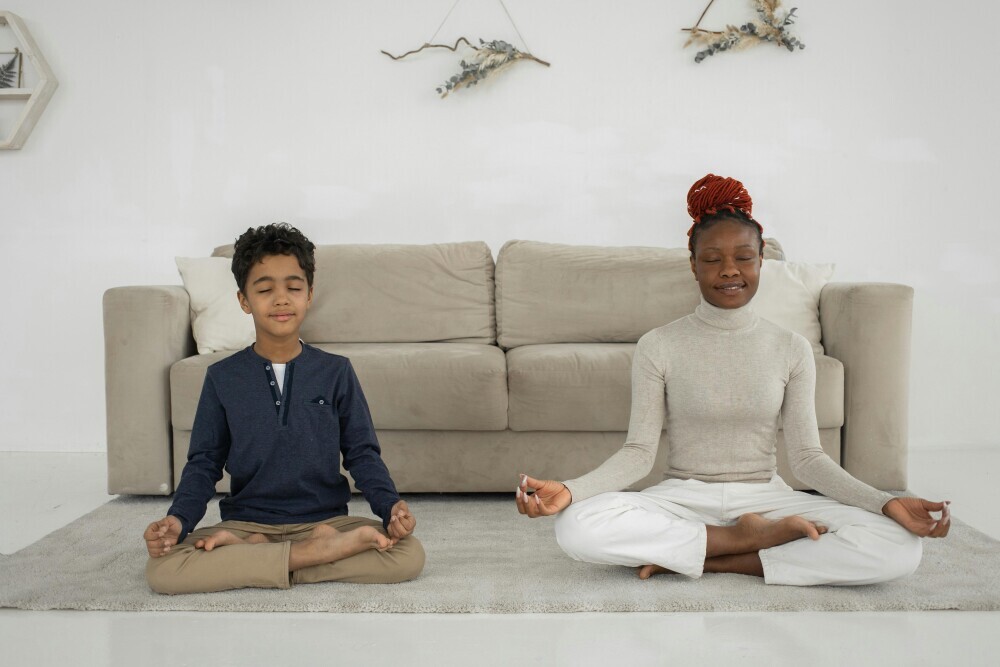
While formal meditation is important, the Buddha also encouraged mindfulness in everything you do.
Whether you’re washing dishes, walking, or sipping tea — you can use any moment to wake up to presence.
Personally, some of my most peaceful moments happen while listening to music or painting. It’s the quiet simplicity of just being there.
Start small:
- Take one mindful breath before opening your phone.
- Feel your feet on the floor before a conversation.
- Notice your posture while you sit at your desk.
The Buddha called this “continuous mindfulness” — the art of staying awake in the ordinary.
8. The Fruit of Mindfulness: Equanimity
The ultimate goal of mindfulness isn’t to eliminate anxiety or sadness. It’s to cultivate equanimity — a calm, balanced mind that remains steady no matter what happens.
When you can observe life without being tossed around by every thought or emotion, you develop a deep inner strength. This is the peace the Buddha spoke of — not a fragile calm, but a grounded, unshakeable one.
“Peace comes from within. Do not seek it without.” — Buddha
And that’s the paradox of mindfulness: the more we stop grasping for peace, the more peace finds us.
Quick Tips for Practicing Mindfulness the Buddhist Way
- Start with the breath. It’s your most accessible anchor.
- Label distractions gently. “Thinking,” “planning,” “remembering,” then come back.
- Practice gratitude. It turns awareness into appreciation.
- End your day with reflection. Ask, “What moments did I truly remember to be present today?”
- Be patient. Like any skill, mindfulness deepens with time and kindness.
Frequently Asked Questions About Mindfulness
1. Is mindfulness the same as meditation?
Not exactly. Meditation is a structured practice; mindfulness is the quality you cultivate during and outside of it.
2. Do I have to be Buddhist to practice mindfulness?
No. Mindfulness is a universal skill, though it originates from Buddhist philosophy.
4. What if I get bored during meditation?
That’s totally normal! Boredom is just another sensation to observe. The key is to stay curious — what does boredom feel like in your body?
5. How long should I practice each day?
Even five minutes of focused mindfulness can make a difference. The more consistent you are, the more your awareness expands.
A Personal Note
If you’ve read my About Me page, you know I didn’t come to mindfulness through formal training or religious study. I came to it through anxiety, self-doubt, and the search for calm.
And that’s exactly why I write about it — because mindfulness isn’t reserved for monks or teachers. It’s for real people, living real lives, learning to find peace in the middle of the noise.
If this resonates with you, I’d love to hear about your journey. What helps you stay mindful? What challenges you? Share your experiences or reflections in the comments — your story might help someone else who’s just beginning.
With love,
Deeana — Meditate4Calm

Disclaimer:
This article is for informational and educational purposes only. It reflects my personal experience and research-based information on mindfulness. It is not a substitute for professional medical or psychological advice. If you’re dealing with severe anxiety or mental health issues, please consult a licensed professional.