If there’s one thing meditation has taught me, it’s that peace isn’t something you stumble into — it’s something you intentionally cultivate. And for me, one of the most powerful tools I’ve used to quiet my mind, soften anxiety, and reconnect to myself has been daily affirmations.
I didn’t start using affirmations because I was trying to be “positive.” I started them because my mind used to wake up already tense — already thinking, already worrying, already bracing for something. I needed a gentle way to shift my energy before the world got loud. And that’s exactly what daily affirmations did for me.
Today, I want to share not only why affirmations work, but also a collection of deeply grounding statements you can use to bring more calm, presence, and emotional steadiness into your day.
Disclosure: This article includes affiliate links. As an affiliate partner, I may earn a small commission from qualifying purchases made through these links. I only share products that align with the values and intentions of Meditate4Calm. Thank you for supporting this website and helping me continue creating empowering, mindfulness-based content.
Why Daily Affirmations Work for Mindfulness & Inner Peace
The mind loves direction.
If you don’t give it one, stress and overthinking will gladly take the lead.
Those first few moments after waking are powerful — your brain is transitioning out of theta and delta brainwave states (the dreamy, subconscious ones) into alpha, which is a highly impressionable, receptive state. This is why your morning mindset often determines how the rest of your day unfolds.
Think of it like opening your front door each morning.
If you don’t consciously decide who gets to step inside — peace or panic — anxiety usually barges in first.
Daily affirmations act as that gentle boundary, helping you:
- Set the emotional tone for your day
- Orient your mind toward presence instead of survival
- Interrupt the automatic rush of worry and mental noise
- Begin your morning with intention rather than reaction
And yes, this isn’t just feel-good language — there’s science behind it.
Neurologically, this makes sense. Research published in Social Cognitive and Affective Neuroscience found that affirmations activate the brain’s ventromedial prefrontal cortex, an area linked to self-valuation, emotional regulation, and reward processing. When this region lights up, the brain becomes less reactive and less defensive under stress.
In simple terms:
Affirmations help your brain feel safer, calmer, and more open to the day ahead.
When I began saying just one grounding affirmation before reaching for my phone, I didn’t expect much. But it created a subtle, almost surprising shift — like giving my mind a soft runway instead of letting it crash-land straight into notifications, emails, and mental chatter.
It’s amazing how something so small can change the way you step into your day. Instead of being pulled into the world’s pace, you get to start from your own.
2. They Strengthen Calm — Not Forced Positivity
I want to be really clear here:
The most effective affirmations are not the overly cheerful ones.
You don’t need to stand in front of a mirror at 6 a.m. hyping yourself up like you’re about to run a marathon. You don’t need to tell yourself you’re unstoppable, brilliant, perfect, or overflowing with joy — especially if that’s not even close to how you’re feeling.
What your mind actually needs in those moments is soothing, not pressure.
When the nervous system is already activated — maybe from poor sleep, stress from the night before, or just that familiar morning tension — trying to force positivity can feel like emotional whiplash. It’s too big of a jump too fast.
Psychologist Dr. Kristin Neff, a leader in self-compassion research, puts it simply:
“Trying to force ourselves into positivity can actually create more stress.”
Why?
Because your body knows when something feels true and when something feels fake.
If you say, “Everything is perfect,” but your chest feels tight and your mind is racing, your nervous system doesn’t relax — it resists. It tightens. It’s like your body whispers, “But… it’s not perfect.”
This is why gentle, believable affirmations are so powerful. They work with your nervous system instead of against it.
Think:
“I can meet this moment with softness.”
Not:
“Everything is perfect and I have no worries.”
One invites calm.
The other adds pressure.
Grounded affirmations create emotional safety because they feel attainable. Your mind doesn’t have to leap; it can simply settle. And when your affirmations are rooted in presence rather than perfection, your whole system relaxes — your breath deepens, your shoulders loosen, and you feel more connected to yourself instead of fighting yourself.
This is where mindfulness truly begins.
3. Repetition Rewires Your Emotional Patterns

One affirmation won’t change your life.
But small moments of repeated safety?
That changes everything.
Think of affirmations like drops of water carving out a smooth path in a stone — one drop isn’t noticeable, but repeated over time, it starts shaping something new. This is exactly how emotional patterns shift inside the brain.
Neuroscience shows that repetition strengthens neural pathways — the same mechanism that makes meditation so transformative. When you repeatedly introduce calming thoughts, your brain begins to form new associations with safety, presence, and emotional steadiness.
A study published in Personality and Social Psychology Bulletin found that affirmations improve problem-solving under pressure, reduce stress, and reinforce a stronger sense of internal capability.
In other words, affirmations help your brain remember who you are beneath the anxiety.
And this is why consistency matters — not intensity.
Every time you repeat a grounding affirmation, you’re:
- teaching your nervous system it can return to safety
- reducing the intensity of stress responses over time
- building emotional resilience in small, subtle layers
- creating a more grounded internal baseline that becomes your “new normal”
It’s not about forcing yourself to feel peaceful.
It’s about gently reminding your body what peace feels like — again and again — until the reminder becomes a familiar home rather than a foreign place.
You’re not forcing calm.
You’re training your body to remember it.
My Go-To Daily Affirmations for Mindfulness and Inner Peace
Calming & Grounding
- In this moment, I am safe.
- My breath brings me back to myself.
- Peace is available to me right now.
- I soften into this moment.
- With each exhale, I release tension.
- Calm is settling into my body.
- I allow my mind to slow down.
- I am centered, grounded, and steady.
- My nervous system is learning peace.
Mindfulness & Presence
- I return to the present with ease.
- Each breath helps me soften and release.
- I can meet this moment gently.
- I pay attention to what’s here now.
- This moment is enough.
- I breathe into clarity and presence.
- I follow my breath back to stillness.
- Peace begins with awareness.
- I choose to be here, now.
Self-Compassion
- I give myself permission to slow down.
- I am allowed to move at my own pace.
- I treat myself with kindness today.
- I am gentle with my inner world.
- It’s okay to feel what I feel.
- I offer myself patience and grace.
- I am worthy of softness.
- I’m learning, growing, healing — and that’s enough.
- I choose compassion over judgment.
Inner Stability
- I trust my ability to handle what comes.
- I choose calm over chaos.
- My mind and body know how to find balance.
- I am rooted in my own strength.
- Peaceful thoughts support me.
- I remain steady even when life moves around me.
- I ground myself in my breath.
- I am safe in my body.
- Stability lives within me.
Emotional Peace
- I let go of what doesn’t belong to this moment.
- I choose thoughts that support my peace.
- Stillness lives within me.
- I release what I cannot control.
- I welcome peace into my heart.
- I allow emotions to move through me gently.
- I honor my feelings without letting them define me.
- I return to peace again and again.
- Calmness expands within me.
Other Tools to Enhance Your Affirmation Practice

Affirmations work beautifully on their own — but pairing them with the right tools can make the practice feel even more grounding, intentional, and embodied. I’ve found that when you combine affirmations with visual cues or physical reminders, they sink deeper into your daily rhythm and become something you feel instead of just repeat.
Here are a few simple tools that can elevate your practice:
1. Journaling with Intentional Prompts
Writing your affirmations down helps anchor them in a deeper, more embodied way. When you slow down enough to put pen to paper, your brain processes the message with more clarity, intention, and emotional resonance.
If you enjoy morning pages, try beginning with:
“Today, I choose the energy of…”
and let the affirmation reveal itself as you write.
If you want a journal that supports this kind of mindful reflection, the Mindful Living Journal is a beautiful option filled with prompts and space for intentional writing

And if you prefer a guided, book-style structure, this mindfulness and journaling companion is another great choice to deepen your daily practice:
Both make the habit feel less like a task and more like a grounding ritual you naturally return to.2. Breathwork + Affirmations
Pairing a slow exhale with each affirmation is one of the quickest ways to anchor calm in the body.
For example:
Inhale…
Exhale: “I am safe.”
Your breath becomes the carrier for the message, helping your nervous system integrate it more fully.
3. Mirror Work (Gentle, Not Forced)
You don’t need to hype yourself up — simply making soft eye contact with yourself while repeating a grounding phrase builds self-trust. This is especially helpful when working with self-compassion or emotional regulation.
4. Using Physical Tools to Keep Affirmations Close
Sometimes you need a reminder in front of you — not just in your mind.
This is where affirmation cards can be incredibly supportive.
I personally love keeping a card on my nightstand, slipping one into my journal, or placing one on my desk to glance at during the day. It turns your affirmation practice into something visual, tactile, and instantly calming.
If you want to try this, here are two beautiful decks I recommend and use myself:
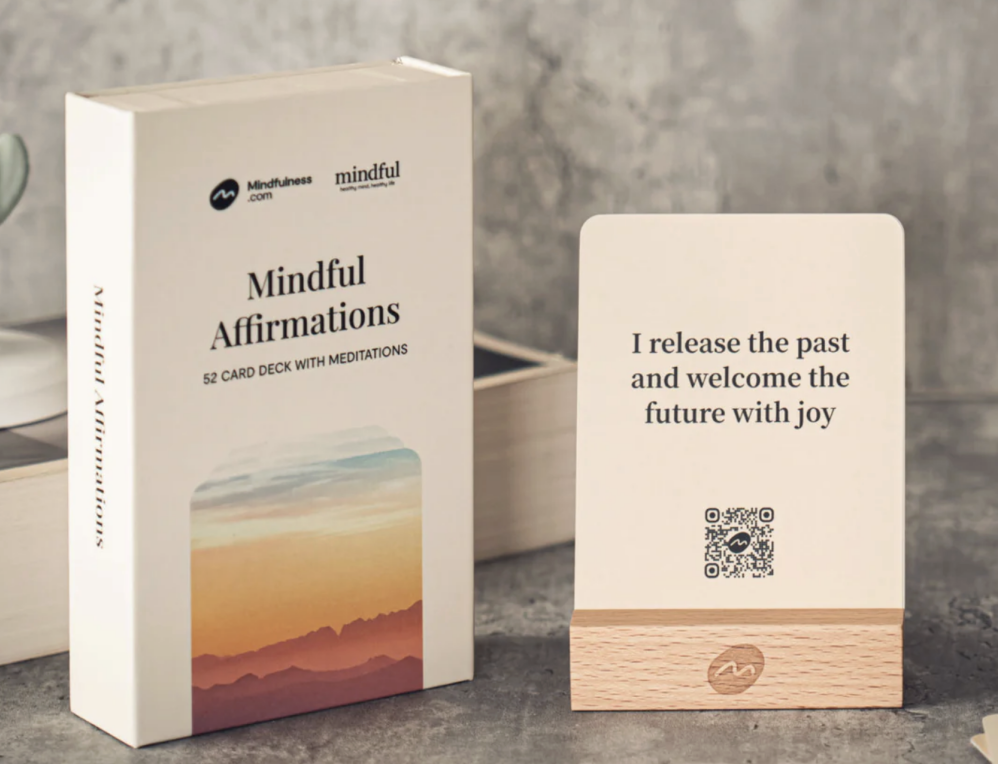
A grounding, minimalist deck filled with calming statements for mindfulness, emotional presence, and inner peace.
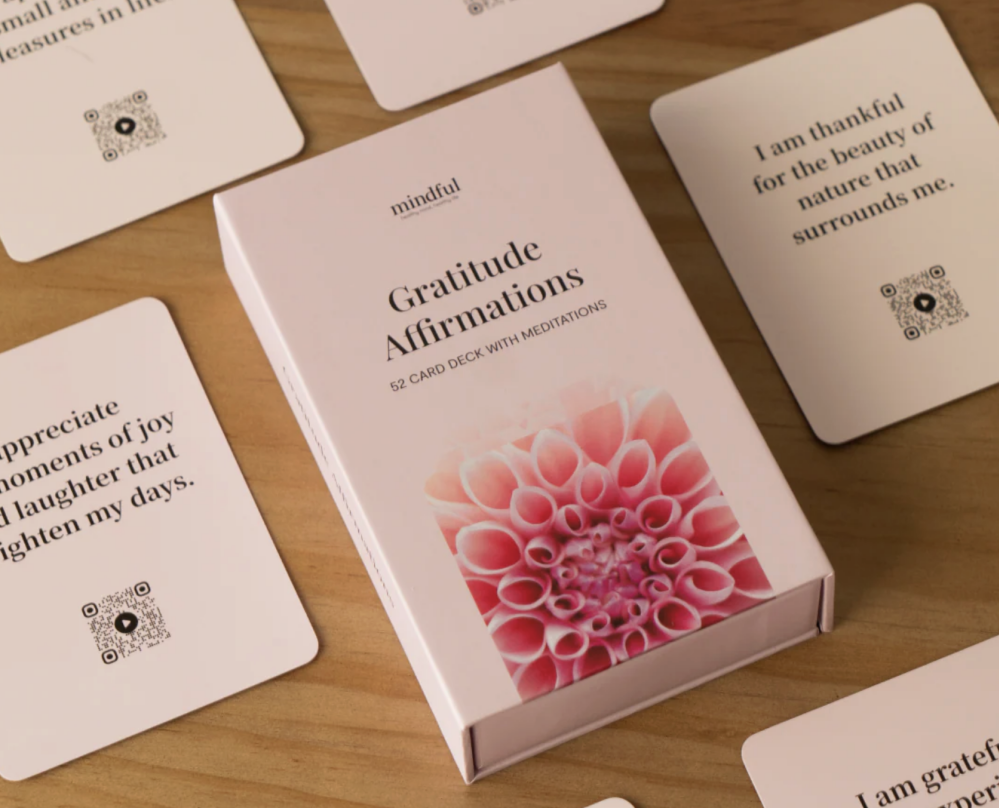
Perfect for shifting your mindset gently toward appreciation without forcing positivity.
These tools aren’t meant to complicate your practice — they simply help you stay connected to the energy you’re trying to cultivate: grounding, gentleness, and emotional clarity.
How I Use Affirmations in My Own Practice

My relationship with meditation and affirmations didn’t come from textbooks or formal training — it came from lived experience. From anxiety that used to greet me before I was even fully awake. From years of navigating overwhelm, self-doubt, and the slow process of rebuilding trust with myself. Over time, affirmations became a grounding tool I could return to in both calm and chaotic moments.
And like most healing practices, my routine isn’t rigid. It shifts depending on what season of life I’m in, how my body feels, or what my mind needs that day. Some weeks I’m consistent with one ritual, and other weeks I intuitively shift into something completely different.
Here are some of the ways affirmations show up in my practice — not all at once, but woven in as needed:
- Some mornings, I start with a single grounding affirmation before I check my phone, just to give myself direction before the day picks up speed.
- During meditation, I’ll repeat a soothing phrase whenever my thoughts drift, guiding my mind with compassion instead of frustration.
- On heavier emotional days, I lean more into self-compassion affirmations, letting them soften the tightness I feel inside.
- I often keep an affirmation card tucked in my journal — usually one from the Mindful Affirmations deck — and I reach for it whenever I need a gentle reminder or a reset.
- And in challenging moments, I come back to one of my personal anchors: “This moment is enough.”
Even whispering it can shift my whole nervous system.
These practices aren’t about being perfect or following a strict routine — they’re about learning to support yourself in the ways that feel right for you, in the moments you need it most. That’s how they’ve helped me heal, reconnect, and deepen my sense of inner stability.
If you’d like to learn more about my story and why this work means so much to me, you can read it here!
Recommended YouTube Videos to Support Your Practice
These videos beautifully complement the themes of mindfulness, presence, emotional regulation, and nervous system healing. Each one offers something a little different, so you can choose what resonates most with where you are on your journey.
1. Jon Kabat-Zinn — “Mindfulness Meditation”
Jon Kabat-Zinn is one of the most respected voices in modern mindfulness, and this guided meditation is a gentle, grounded introduction to what it really means to be present. He helps you notice your breath, soften into your body, and let thoughts pass without getting tangled in them — which makes it a perfect companion to grounding or calming affirmations.
2. Dr. Joe Dispenza — “Rewiring Your Brain Through Thoughts”
Dr. Joe Dispenza breaks down the neuroscience behind how repeated thoughts reshape your emotional patterns. His explanation of neural pathways makes it easier to understand why affirmations and meditation work, especially if you’re someone who feels more connected when you understand the science behind the practice.
3. Tara Brach — “RAIN: A Meditation for Difficult Emotions”
Tara Brach’s RAIN method (Recognize, Allow, Investigate, Nurture) is one of the most powerful approaches for navigating heavy or overwhelming emotions. This meditation pairs beautifully with self-compassion affirmations because it teaches you how to meet your inner experience with curiosity and kindness instead of judgment or avoidance.
Frequently Asked Questions
1. Do affirmations really work for anxiety?
Yes — especially when they’re paired with mindful breathing or grounding practices. Research shows that affirmations can reduce stress by strengthening emotional regulation and helping the nervous system settle.
2. How many affirmations should I say per day?
Just 1–3 is enough for your brain and body to absorb the message. With affirmations, consistency matters more than quantity.
3. Can affirmations replace therapy?
No, affirmations are a supportive tool rather than a standalone treatment. They can complement therapy beautifully, but they’re not meant to replace professional mental health care.
4. What if affirmations feel fake?
If an affirmation feels forced, choose a gentler one that feels “true enough” for your nervous system. They don’t need to promise perfection — they simply need to guide you back into presence, like replacing “I am completely calm” with “I am learning to feel calmer, one breath at a time.”
Final Thoughts
There were mornings when I would wake up already overwhelmed — before my eyes were even fully open. My mind would start racing, my breath would tighten, and I’d feel like I was somehow already behind on a day that hadn’t even begun. Affirmations weren’t a magical fix, but they were one of the first practices that helped me interrupt that spiral. They offered me a moment — just one small, steady moment — to choose calm before chaos chose me.
That’s why I love hearing what resonates with you.
Which affirmation softened something inside you today?
Did one help you breathe a little deeper or bring you back into your body?
Maybe you have your own grounding phrase you whisper during stressful moments, or a morning ritual that helps you reconnect with yourself. If you’re open to it, share it in the comments. Your words might be exactly what someone else needs to read on their own healing journey.
This space isn’t just about meditation — it’s about community, connection, and learning how to show up for ourselves with more gentleness than we were ever taught.
Thank you for being here, for reading, and for choosing peace even when it feels hard. That choice matters more than you know.
With love,
Deeana — Meditate4Calm

Disclaimer: This article is for educational and inspirational purposes only. It is not intended to diagnose, treat, or replace professional mental health support. If you are experiencing severe anxiety or emotional distress, please consult a licensed professional.
References
- “Theta Waves: How They’re Linked to Sleep, Creativity, and Mindfulness.” Healthline.
https://www.healthline.com/health/theta-waves - “Delta Brainwaves: What They Mean & Why They Matter.” Healium.
https://tryhealium.com/blog/delta-brainwaves/ - Critcher, C. R., Dunning, D., & Armor, D. A.
“Self-Affirmation Activates Brain Systems Associated with Self-Related Processing and Reward and Is Reinforced by Future Orientation.”
https://www.researchgate.net/publication/283545154_Self-Affirmation_Activates_Brain_Systems_Associated_with_Self-Related_Processing_and_Reward_and_is_Reinforced_by_Future_Orientation - Creswell, J. D., et al.
“Affirmation reduces physiological reactivity to health-threatening stress.”
National Institutes of Health (PMC).
https://pmc.ncbi.nlm.nih.gov/articles/PMC11591838/ - Critcher, C. R. & Dunning, D.
“Self-Affirmation and Perspective-Taking: When Feeling Good Helps You Do Good.”
University of Michigan — Self & Social Identity Project.
https://sites.lsa.umich.edu/sasi/wp-content/uploads/sites/275/2015/11/Critcher_AffPersp.pdf - Guided Mindfulness Meditation — Jon Kabat-Zinn.
A foundational mindfulness practice from the creator of MBSR (Mindfulness-Based Stress Reduction).
https://www.youtube.com/watch?v=3nwwKbM_vJc - Dr. Joe Dispenza — Video on Rewiring the Brain Through Thought
In this video, Dr. Joe Dispenza explains how repeated thoughts and focused attention help reshape neural pathways.
https://youtu.be/JDbqsgMwxR8?si=PIP7qNZO6o-6Fz5v - “RAIN: A Meditation for Difficult Emotions” — Tara Brach.
A gentle guided meditation using the RAIN method: Recognize, Allow, Investigate, Nurture — perfect for deepening self-compassion affirmations.
https://www.youtube.com/watch?v=mEf_pj4PNfg