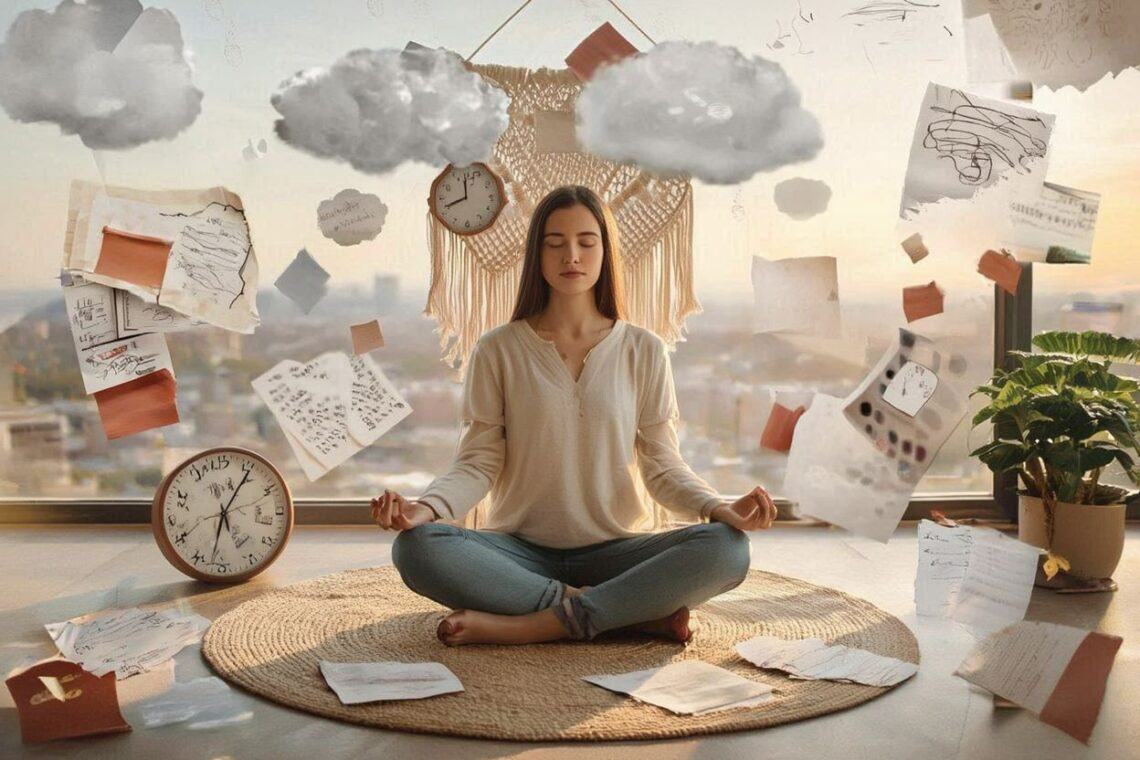
If you’re anything like me, you’ve had this exact moment: You finally remember you want to meditate… right as you’re answering one last email, rinsing a dish, trying to find your keys, and thinking about the ten other things you still need to do.
And then the thought appears:
“I’ll do it later when life calms down.”
Except… life doesn’t really calm down, does it?
Here’s what I’ve learned (and what I want you to feel in your bones by the end of this article): Meditation isn’t something you “fit in” once you become a calmer person with a quieter schedule. Meditation is one of the ways you become calm inside a real schedule.
And if you’re reading this while your mind is already saying, “Okay, but I seriously don’t have time,” I want you to know—I believe you. I’m not here to argue with your reality. I’m here to help you work with it.
I’m Deeana, and meditation became a turning point in my life—so much so that It has inspired me to create this space Meditate4Calm a grounded space for people who want peace. If you want to learn a little more about my personal story and why I’m so passionate about this topic, you can read more about it here.
Let’s talk about how to find time for meditation without waiting for your life to magically become easier.
Affiliate Disclaimer: Some links on Meditate4Calm may be affiliate links, meaning I may earn a small commission at no extra cost to you. I only share resources I genuinely believe can support you.
Meditation gets marketed like a luxury—candles, hour-long sessions, silent retreats.
But the way I see it? Meditation is nervous-system hygiene. It’s mental training. Emotional regulation. Attention practice. A way to come home to yourself.
And yes—there’s solid science behind why it helps.
What Studies Say About Meditation
Stress, anxiety, and low mood: A major systematic review and meta-analysis published in JAMA Internal Medicine found that meditation programs showed moderate evidence for improving anxiety and depression outcomes compared with control conditions.
Anxiety and mood symptoms: A widely cited meta-analysis in Journal of Consulting and Clinical Psychology concluded mindfulness-based therapy is a promising intervention for anxiety and mood problems in clinical populations.
Sleep quality: A randomized clinical trial published in JAMA Internal Medicinefound a mindfulness meditation program improved sleep quality for older adults with sleep disturbances.
Attention (yes, even short sessions):Research suggests that a brief 10-minute guided mindfulness meditation can improve aspects of attention in novice meditators.
Brain changes over time: Research on mindfulness-based stress reduction has been associated with changes in gray matter density in areas related to learning, memory, emotion regulation, and self-referential processing.
If you’ve ever felt like meditation “should be helping” but your mind is still busy, remember: the goal isn’t to stop thinking. The goal is to relate to your thinking differently.
As mindfulness teacher Jon Kabat-Zinn puts it:
“Mindfulness is awareness that arises through paying attention, on purpose, in the present moment, non-judgementally.” — Jon Kabat-Zinn
That’s it. That’s the practice. Awareness—on purpose—right now.
Medical Disclaimer: The content on Meditate4Calm is for educational and informational purposes only and is not medical advice. Meditation is not a substitute for professional care. If you have a medical condition or mental health concerns, please consult a qualified healthcare professional.
You Don’t Need More Time
Most people try to “start meditating” by aiming for 20–30 minutes a day. And then they fail. And they decide they’re bad at meditation. But what if the real issue isn’t you? What if the real issue is your entry point is too big for your current life?
Micro-meditation is real meditation
If you only have:
60 seconds
3 minutes
5 minutes
10 minutes
…that counts. And it adds up.
Think of it like brushing your teeth. You don’t wait until you have 40 minutes and a perfect bathroom vibe. You do it because it’s maintenance. Meditation can be the same.
Assessing Your Daily Schedule
Before we talk technique, do this once:
The “Where Are the Minutes Going?” scan
Grab your notes app or a piece of paper and write:
What time do I wake up?
What are the 3 most consistent “transition moments” in my day?
Transition moments are things like:
right after you wake up
before you start work
after you park your car
before you open social media
after lunch
before your shower
when you get into bed
These transitions are the sweet spot for meditation because your brain is already shifting gears. The easiest time to meditate is not “when you have time.” It’s when you already pause. Add meditation to an existing pause. So what are your “transition moments?”
Setting Realistic Goals
If you want consistency, start smaller.
Here’s a simple ladder:
Week 1: 2 minutes a day
Week 2: 5 minutes a day
Week 3: 7–10 minutes a day
Week 4: 10–15 minutes a day
And if you miss a day, you don’t “start over.”You just continue. This matters because meditation isn’t just about calm—it’s about trust.
You’re building a relationship with yourself that says: “I show up for me, even in small ways.”
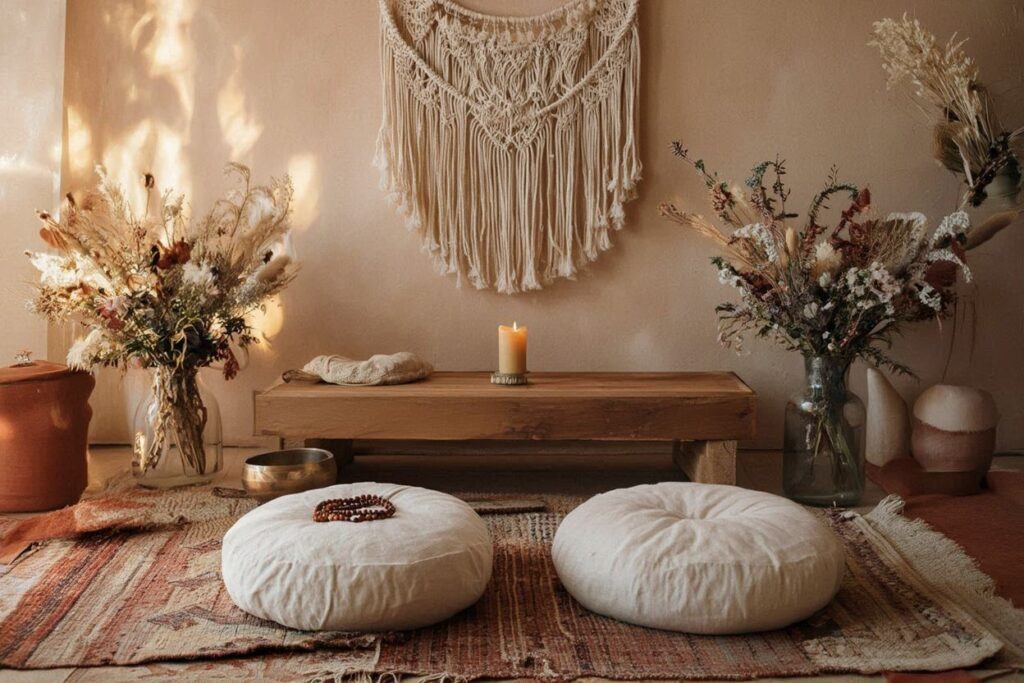
A “meditation space” doesn’t have to be aesthetic. It has to be available. Your brain learns by association. The more you pair one spot with one intention(“this is where I come back to myself”), the easier it becomes to drop in over time.
So if you always meditate:
in the same chair
on the same corner of your bed
in the same spot on the floor
…it becomes easier to settle, faster. Your body starts to recognize the cue before your mind even catches up.
What a meditation space actually needs
A consistent location
A consistent cue (pillow, blanket, timer, headphones)
Low friction (no rearranging furniture, no “setup ritual” that takes 10 minutes)
That’s it. The goal is not a perfect space. It’s a repeatable one.
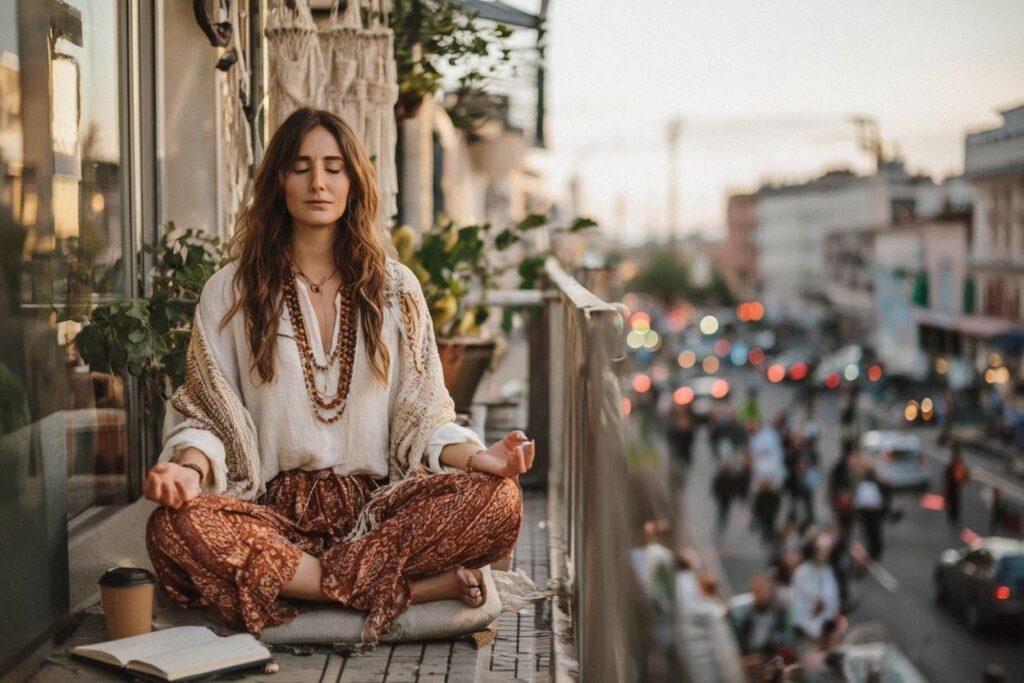
But what if you’re not at home?
Here’s the truth: you can create a “meditation space” anywhere if you use the same micro-environment and the same cue consistently.
At work
Your meditation space might be:
your car before you walk inside
a quiet corner of the parking lot
a break room chair with your headphones on
a bathroom stall for 60 seconds of breathing
your desk with your eyes lowered and one hand on your chest
The key is choosing one option you can repeat. When the location stays consistent, your nervous system starts to treat it like a safe “reset station.”
While commuting
Meditation doesn’t have to mean closing your eyes. If you’re on a train, bus, or even walking:
feel your feet or the seat beneath you
follow your breath for 10 cycles
relax your jaw and shoulders on the exhale
listen to a 3–5 minute guided session with headphones
If you drive, you can do a pre-drive or post-drive practice: two minutes parked before you turn the key, or one minute in the driveway before going inside.
When you’re traveling
This is where the cue matters more than the room. Bring one “portable anchor,” like:
the same pair of headphones
a small scarf or mini blanket
a travel-sized pillow
a specific playlist or short guided meditation you always use
Over time, that cue becomes your “space,” even if you’re in a hotel, at a family member’s house, or somewhere loud and unfamiliar.
Quick Tip
Pick one “home base” spot for your main practice, and one “portable” spot for busy days. Example: bed corner at home + car pause at work.Because the real win isn’t creating the perfect environment. It’s creating an environment that makes it easier to return to yourself—again and again.
Meditation Habit Stacking
One of the most powerful ways to stay consistent is habit stacking:
After I do X, I will meditate for Y minutes.
Examples:
After I brush my teeth, I’ll meditate for 2 minutes.
After I park at work, I’ll breathe for 60 seconds before going inside.
After I make my coffee, I’ll sit and listen to a 5-minute guided meditation.
Meditation + walking
Walking meditation is incredible if sitting feels hard.
If meditation is only something you do “when you remember,” it won’t stick.
So let’s make it easier.
3 simple planning strategies
Put it on your calendar (like a meeting). Even a 5-minute appointment is a signal: “This matters.”
Use a reminder that tells you what to do. Not: “Meditate.” But: “2 minutes—breathe with your hand on your chest.”
Create a ‘minimum version’ plan. On chaotic days:
60 seconds of breathing
or one mindful sip of water
or one slow exhale
This is how you build consistency without relying on motivation.
Managing Expectations
Some days meditation feels peaceful. Some days it feels like your brain is a browser with 37 tabs open. Both are valid sessions. And honestly? The “37 tabs” days are often the ones doing the most for you—because meditation isn’t a mood. It’s a skill.
Think of it like strength training: you don’t build strength by never wobbling—you build it by meeting resistance and staying with it. In meditation, the resistance is distraction, and the practice is noticing it… and coming back.
What You’re Strengthening
Awareness: “I’m spiraling.”
Choice: “I can come back instead of following this thought.”
Regulation: “I can soften my body even if my mind is loud.”
Self-trust: “I don’t abandon myself because it’s imperfect.”
That’s resilience: the ability to come back to center after you’ve been pulled away—by stress, fear, overstimulation, or a hard day.
Technology as a Tool
You don’t have to meditate alone. Guided sessions are often the easiest way to build momentum.
Here are a few credible, beginner-friendly resources you can use immediately:
YouTube videos worth saving
“All it takes is 10 mindful minutes” — Andy Puddicombe (TED Talk) A powerful reminder that meditation doesn’t have to be complicated.
5-Minute Guided Breathing Meditation — Diana Winston (UCLA MARC) A short, grounding practice that gently guides you back to your breath and body. It’s especially helpful when you’re feeling scattered or overstimulated—simple instructions, steady pacing, and an easy way to reset your nervous system in just a few minutes.
Jon Kabat-Zinn mindfulness talk + practice (Wisdom 2.0) A grounded, practical teaching on what mindfulness really is (and what it isn’t), with guidance you can apply immediately in everyday life. It’s less about “clearing your mind” and more about learning to meet your experience with awareness and steadiness—especially when life feels busy or intense.
Free guided meditation library
UCLA’s Mindful Awareness Research Center (UCLA Mindful / MARC) has a free library of guided meditations—most are 5–19 minutes, which makes them perfect for a busy day when you don’t have the energy to “plan” a practice.
You can choose what you need in the moment (breath meditation, body scan, loving-kindness, working with difficult emotions, sleep support), and either stream or download the audios.
One feature I really love: many of the meditations are available in multiple languages, so it’s a great resource if you’re bilingual or want to share the practice with family and friends.
I don’t live in a monastery. I live in the real world—responsibilities, plans, deadlines, and days that move too fast. So I stopped trying to make meditation an “event” I had to earn, and instead made it something I return to again and again throughout my day.
Here’s what it looks like for me now—and I want to say this upfront: don’t worry if you aren’t here yet. I’ve been meditating for a long time, so my sessions are longer because the habit is already built. When I first started, my practice was much shorter—5 to 10 minutes a day—and I leaned heavily on guided meditations. Those smaller sessions helped me develop consistency… and that’s why I truly believe micro-meditations work.
My current daily rhythm
Morning (30–60 minutes): I make time every morning for meditation using meditation music. This is my foundation—how I meet myself before the world starts asking things from me. And one of the biggest reasons this works for me: I don’t touch my phone until after my meditation is complete. No scrolling, no messages, no quick “just checking.” I protect that space because the moment I let the outside world in, my nervous system starts responding to it. I like to start the day from my center, not from my notifications.
Morning intention + reflection (a few minutes): After meditation, I’ll often journal about what I experienced, or write a simple intention for the day. Lately, I’ve also started working with oracle cards. They helps me reflect, focus, and stay connected to what I want to embody.
Anchors throughout the day (micro-meditations): I anchor myself with mindful breathing—little resets that bring me back into my body. My anchors are usually:
As soon as I wake up (meditation before anything else)
After I work out (closing my eyes and focusing on my heart center)
Between tasks (one slow exhale, relaxing my jaw and shoulders)
These tiny moments matter more than people think. They keep my nervous system from running the whole day on autopilot.
Evening wind-down (10–15 minutes): At the end of the day, I usually do a shorter session right before sleep—around 10–15 minutes. I’m not trying to “fix” the day. I’m letting it settle. It helps my body switch out of go-mode and into rest.
What I Hope You Remember
My meditation practice is always evolving and changing—and it’s okay if yours does too. Some seasons will be longer sits. Some seasons will be five minutes and a few mindful breaths. What matters most is that you keep creating ways to come back to yourself.
If you enjoy using affirmations as part of your meditation (especially when your mind is racing), you might like these:
“Be present, be patient, be gentle, be kind… everything else will take care of itself.” - Andy Puddicombe
FAQ’S
1) Does 5 minutes of meditation really do anything?
Yes—especially as a consistency builder. Research suggests even brief guided mindfulness sessions (like ~10 minutes) can improve aspects of attention in beginners. But the bigger win is this: 5 minutes turns meditation into a habit. And habits change lives.
2) What if my mind won’t stop thinking?
That’s normal. Meditation is not “no thoughts.” It’s noticing thoughts and returning to an anchor (breath, sound, body). Mindfulness is often defined as present-moment awareness with a nonjudgmental attitude.
3) Is it better to meditate in the morning or at night?
Whatever you’ll do consistently. Morning is great for setting your nervous system tone; evening is great for unwinding. Pick the time with the least friction.
4) Do I need a quiet house to meditate?
No. Quiet helps, but it isn’t required. You can meditate with headphones, with a fan on, even in your car for 2 minutes. The practice is returning—not controlling the environment.
5) What type of meditation is best for busy people?
Guided meditations and breath-focused practices tend to be easiest when you’re starting. Walking meditation is also great if sitting feels difficult.
6) I tried meditation and felt worse. Is that normal?
Sometimes slowing down can bring awareness to feelings you’ve been pushing away. If you have a trauma history or intense anxiety, go gently, keep sessions short, and consider professional support. (Meditation is a tool—not a substitute for medical care.)
If you’re busy, you’re not failing. You’re living. And you still deserve peace—not someday when life slows down, but now, right inside the life you already have.
Start small. Start imperfect. Start in the cracks of your day. Even one mindful breath is a beginning. Even two minutes counts. Especially if you’re just starting, please hear me on this: you don’t need to do meditation “right” to benefit from it. You just need to keep coming back—gently, consistently, in whatever way fits your season.
My hope is that this guide helped you see that meditation doesn’t have to be an all-or-nothing practice. It can be a thread you weave into your life—one moment at a time—until it becomes something you genuinely crave, not something you pressure yourself to do.
And if you want to, I’d love to hear from you: What’s the hardest part about finding time for meditation right now—schedule, consistency, distractions, or expectations? Share your experience, your struggles, or your wins in the comments. Your honesty might be the exact thing someone else needed to read today.
With love, Deeana — Meditate4Calm
Medical Disclaimer: The content on Meditate4Calm is for educational and informational purposes only and is not medical advice. Meditation is not a substitute for professional care. If you have a medical condition or mental health concerns, please consult a qualified healthcare professional.
“Be not afraid of growing slowly; be afraid only of standing still.”