
A few years ago, I was a mess of emotions—reactive, overwhelmed, and constantly feeling like my feelings were in the driver’s seat while I was just along for the chaotic ride. I’d snap at my partner over small things, spiral into anxiety about work emails, and couldn’t shake off bad moods for hours (sometimes days). I knew something had to change, but I didn’t realize that change would come from something as simple as sitting still and breathing.

That’s when I discovered meditation wasn’t just about relaxation—it was about developing emotional regulation skills I never knew I needed. As I share on my About page, meditation helped me reduce anxiety, build confidence, and let go of the person I used to be. But more than that, it taught me how to work with my emotions instead of being controlled by them.
Disclaimer: This content is for educational and informational purposes only and is not a substitute for professional medical advice, diagnosis, or treatment. Always consult with qualified healthcare providers regarding mental health concerns, emotional difficulties, or before beginning any new wellness practice.
What Emotional Regulation Actually Means
Let’s get one thing straight: emotional regulation isn’t about becoming a zen robot who never feels anything. It’s not about suppressing anger or pretending everything’s fine when it’s not.
Instead, emotional regulation is a learnable skill set that includes recognizing emotions early (before they explode), understanding what you’re actually feeling and why, modulating the intensity of emotions, choosing appropriate responses rather than just reacting, and recovering from emotional disturbances more quickly.
Think of it like learning to surf. You don’t control the waves—the emotions will come regardless. But you can learn to ride them skillfully instead of being knocked over every time.
The Magic Gap: Space Between Stimulus and Response
Viktor Frankl, the renowned psychiatrist and Holocaust survivor, wrote something that changed how I understand my own reactions:
“Between stimulus and response there is a space. In that space is our power to choose our response.”
Here’s what blew my mind: meditation literally creates this space in your brain. Research from Harvard Medical School and Massachusetts General Hospital shows that meditation increases activity in the ventrolateral prefrontal cortex, which acts like a brake pedal for your automatic emotional reactions. This neural buffer—often just 1-2 seconds—is where emotional regulation actually happens.
When someone cuts you off in traffic, that tiny gap is the difference between honking aggressively (and ruining your morning) or taking a breath and moving on. I didn’t believe this until I experienced it myself. After a few weeks of consistent meditation practice, I could feel that pause.
Your Brain on Meditation: The Neuroscience That Changes Everything

Researchers at Harvard Health found that after just eight weeks of mindfulness meditation practice, participants showed increased gray matter concentration in the hippocampus (important for learning and memory) and regions associated with self-awareness and compassion. Even more impressive? The amygdala—your brain’s fear and stress center—showed decreased gray matter, which correlated with lower stress levels.
Let me translate: meditation physically restructures your brain to be less reactive and more responsive.
The Reappraisal Revolution
One of the most powerful emotional regulation strategies is cognitive reappraisal—basically, reframing how you interpret emotional situations. Meditation strengthens the prefrontal cortex regions responsible for this skill. Studies show that regular meditators can reappraise situations 30-40% more effectively than non-meditators.
The Simple Power of Naming Your Emotions

Here’s something that sounds almost too simple to work: just naming what you’re feeling can reduce its intensity by up to 30%.
Research demonstrates that affect labeling—saying “I’m feeling anxious” or “This is anger”—activates the right ventrolateral prefrontal cortex while reducing amygdala activation. In other words, identifying and naming emotions transforms them from overwhelming experiences into observed phenomena.
During meditation, we practice this constantly. “Oh, there’s anxiety.” “Here comes frustration.” We’re not judging these emotions—we’re simply acknowledging them. I used to feel anxiety as this huge, terrifying wave. Now? When I notice it and name it, it becomes more manageable.
Expanding Your Capacity: Window of Tolerance and Early Detection
Psychiatrist Dan Siegel introduced the concept of the “window of tolerance”—the optimal arousal zone where you can function effectively. When you’re outside this window, you’re either in hyperarousal (anxious, panicked, angry) or hypoarousal (shut down, numb, dissociated). Here’s the game-changer: meditation measurably expands this window. This means you can experience stronger emotions without completely falling apart or shutting down. For me, this has been transformative. Things that used to send me into panic mode now feel challenging but manageable.
Most people only recognize emotions after they’ve reached high intensity. Meditation develops interoceptive awareness—the ability to detect subtle bodily signals of emerging emotions:
- Shoulder tension: Often the first sign of stress building
- Breathing changes: Shallow or rapid breathing signals anxiety starting to surface
- Temperature shifts: Feeling suddenly hot or cold can indicate emotional activation
- Gut sensations: That “knot in your stomach” is your body’s early warning system
- Jaw clenching: Physical tension that reveals underlying frustration or anger
When you catch emotions early, regulating them becomes exponentially easier. This skill alone has saved me countless times. Now I can feel irritation building and take a walk before I snap at someone I love.
The Power of Distance and Acceptance

One of meditation’s most profound gifts is teaching you to observe your thoughts and emotions rather than being consumed by them. This is called decentering—creating psychological distance from your internal experience. Instead of “I am angry,” you notice “anger is present.” The first time I experienced this, it felt almost magical. A wave of sadness came during meditation, and instead of getting swept away, I watched it rise, peak, and gradually fall. That same skill now helps me in everyday life when difficult emotions show up.
Here’s something counterintuitive: accepting emotions often regulates them better than trying to control them. Research shows that acceptance-based strategies reduce both the duration and intensity of emotions while requiring less cognitive effort than suppression or avoidance. Meditation trains this experiential acceptance. You sit with discomfort without immediately trying to fix or escape it. This doesn’t mean you passively accept everything. It means you stop adding suffering to suffering. Instead of feeling anxious about feeling anxious, you just feel the anxiety. And paradoxically, that makes it much easier to work with.
The bounce-back factor: While meditation doesn’t necessarily prevent emotional reactions, it dramatically accelerates emotional recovery. Studies measuring physiological markers like heart rate and cortisol show that meditators return to baseline 50-70% faster after emotional provocations. Life will upset you. People will disappoint you. But when you can recover faster, those difficult moments don’t derail your entire day.
Building Your Emotional Regulation Toolkit
The RAIN Technique
This is my go-to when emotions feel overwhelming:
- Recognize: Notice the emotion arising without judgment
- Accept: Allow it to be present without trying to fix it
- Investigate: Explore with curiosity—where do you feel it in your body?
- Non-identification: Remember that you are not the emotion
Emotional Surfing
Rather than fighting emotional waves, meditation teaches you to surf them—riding the natural rise and fall of emotional intensity with skill and balance. Here’s how emotional surfing works:
- Recognize the wave is coming: Notice the emotion building without immediately trying to stop it
- Get on your board: Ground yourself in your breath or body sensations as your anchor
- Ride the rise: Allow the emotion to intensify naturally, observing it without adding more fuel through rumination
- Stay balanced at the peak: Remember that all emotions peak and then naturally decline—you don’t have to do anything
- Coast down: Notice as the intensity naturally decreases, just like a wave rolling back to shore
- Return to calm waters: Allow yourself to settle back into your baseline state, knowing you successfully navigated the emotional experience
The key insight: emotions have a natural lifespan. They rise, peak, and fall on their own—usually within 60-90 seconds if you don’t resist them or add mental stories that keep them going.
How Meditation Builds Advanced Emotional Skills
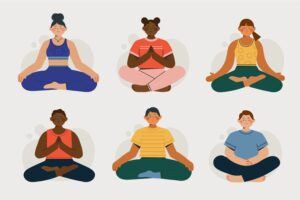
Meditation enhances emotional regulation across four key stages: situation selection and modification (choosing environments that support you), attentional deployment (shifting focus strategically), cognitive change (reframing situations), and response modulation (choosing values-aligned responses even when emotions are strong).
Beyond these stages, meditation also enhances emotional granularity—your ability to distinguish between nuanced emotional states. Instead of just feeling “bad,” you learn to recognize whether you’re frustrated, disappointed, anxious, or sad. Research shows that higher granularity correlates with better regulation and mental health outcomes.
One of meditation’s most underrated benefits is how it develops self-compassion—treating yourself with kindness during emotional difficulty. Neuroscientific research shows that self-compassion activates caregiving neural networks while deactivating self-criticism circuits. When I first started meditating, I was incredibly hard on myself. But gradually, I learned to meet my struggles with kindness. That same compassion now shows up when I’m having a hard time emotionally.
Bringing It All Together: The Real Goal
Here’s the thing: the formal practice is just training. The real magic happens when you transfer these skills into daily life through mini-meditations throughout the day, applying regulation skills in real-time, and reflecting on emotional experiences afterward. The integration isn’t always smooth. You’ll forget to use these tools. You’ll get swept away by emotions despite your practice. That’s completely normal and part of the process.
The profound insight I’ve gained through meditation is this: emotional regulation isn’t about achieving permanent calm or eliminating difficult emotions. It’s about developing a sophisticated skillset that allows you to work skillfully with the full range of human emotional experience.
You’ll still feel sad, angry, anxious, and frustrated. But you’ll have more choice in how you respond. You’ll recover faster. You’ll maintain your effectiveness and wellbeing even amidst life’s inevitable challenges.
Your Turn
I’d love to hear about your experience with meditation and emotional regulation. Have you noticed changes in how you handle difficult emotions? What techniques work best for you? Drop a comment below and share your struggles, wins, or questions.

With love,
Deeana — Meditate4Calm


14 Comments
Rosemary
Yeah I feel like I burned a lot of bridges, without emotional regulation. This guide really helped me, I just wish I could take back everything I lost because of my own immaturity and lack of values. People really are not replaceable!
Deeana
Thank you so much for your time and questions.
I’m so glad that this guide helped you out—what part helped the most?
I hear the weight of regret in your words. The fact that you recognize the bridges you’ve burned and can identify lack of emotional regulation as the cause shows tremendous growth. You’re absolutely right—people are not replaceable, and I’ve been there too, wishing I could undo past mistakes.
Here’s what meditation has taught me about regret: we can’t change the past, but we can change our relationship with it. I’ve learned to hold my regrets with compassion rather than letting them become a weapon against myself. The person who burned those bridges isn’t exactly who you are today.
The work you’re doing now is creating a foundation for healthier connections moving forward.
Thank you again for reaching out.
Rosemary
yeah I just kinda realized I will always be the insecure one, because of everything I been through. Instead of creating chaos on a stable partner, I learnt how to feel shame and guilt for my actions and embraced the disappointment instead of avoiding it. Ruining other peoples perception and repeating the same truama that happened to me wasn’t okay.
Deeana
Thank you for opening up like that. I really relate — past relationships taught me a lot aa well they taught me about how unresolved hurt can spill over onto people who never caused it. What you shared shows real growth. Learning to sit with guilt, shame, and disappointment instead of creating chaos takes a lot of self-awareness.
The fact that you can see where your behaviors came from, and that you don’t want to repeat that trauma, is already a sign that you’re breaking the cycle. You’re not the same person you were when you were hurting, and you deserve to recognize that.
I respect the work you’re doing. It’s not easy, but it’s meaningful — and it really does change everything moving forward.
Rosemary
yeah i stopped defensive posturing, overexplaining, i realized it brought a lot of pressure to my partners. I didn’t like the superficial it caused because it always forced the person I was with to do the same. The hurt caused me to overexplain, and need so much validation for any kind of emotion i felt.
Rosemary
Do you also feel like your attachment style is more avoidant? I noticed that once I started listening to myself.
Deeana
I’m actually not completely sure, but the online attachment tests I’ve taken usually place me in the fearful-avoidant category-wanting closeness but also pulling back when things feel overwhelming or uncertain.. The more I think back on my past relationships — and especially my current one — the more I can see how these patterns show up for me.
I haven’t done a deep dive into attachment theory yet, but I feel like this might be a really good time to explore it more intentionally. If understanding attachment styles can help me grow personally and help me show up better in my writing, then I definitely want to dig into it further. I’m adding it to my list of topics to research for the blog.
And I’m honestly so glad you came to that realization for yourself. Self-awareness is such a powerful first step. We can’t change what we’re not aware of — so truly, kudos to you for listening to yourself and recognizing your own patterns.
Rosemary
I realized I was consistently reconstructing narratives to fit my own approach, like things were always about “getting better within myself” instead of facing the accountability. I would use my own lashing out as an excuse to make the other person pull back, and reassure myself of what I was thinking. I at one point blamed my partner of being an avoidant but he was really direct most of the time.
Rosemary
I’m also saying because I should have never emotionally crushed good people and boyfriends I had, they didn’t really deserve that because they were just trying their best to regulate me and themselves. I put them in horrible positions and regret it to this day, I will never get those people back who I had in my life. Only because I wanted to feel in control.
Deeana
I can definitely relate to this when I think about some of my past relationships. It’s really hard to look back and realize how our own unhealed parts showed up and affected people who were actually trying.
Most of us didn’t act out of malice — we acted out of fear, pain, and patterns we didn’t yet understand. Looking back with regret is normal, but it’s also important to remember that who you were then is not who you are now. Awareness creates space for change, and you’re clearly doing that work.
You may not get those exact people back, but you can become someone who shows up differently moving forward — and that’s what really matters.
Rosemary
Yeah I can only meet people as far as I allow them, my safety depends on it I ran so far out of fear and pain and I let my unwillingness to connect with people. I haven’t been in a healthy relationship, yet and truly know what one is. I keep everything surface now because the last person I let in too deep, almost ruined me. My idea of an relationship is very surface because of all the neglect I suffered through.
Rosemary
avoidance wrapped in whatever I can distract myself, is what I call it. It can’t harm me, and I’m “safe.” I hope you had a happy thanks giving!
Deeana
Thank you so much! I hope your Thanksgiving was filled with joy, comfort, and a little bit of peace too.😊
Rosemary
It was quiet, slow and relaxing. The storms are quiet nowadays and rain doesn’t have a constant clutter on me.